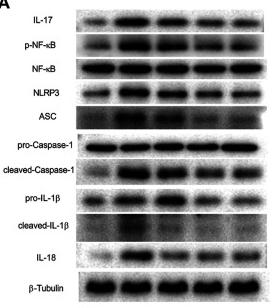
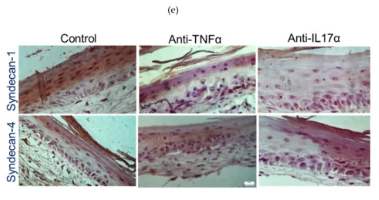
Product: IL17A Antibody
Catalog: DF6127
Description: Rabbit polyclonal antibody to IL17A
Application: WB IHC IF/ICC
Cited expt.: WB, IHC, IF/ICC
Reactivity: Human, Mouse, Rat
Prediction: Pig, Bovine, Horse, Sheep, Rabbit, Dog
Mol.Wt.: 18kDa; 18kD(Calculated).
Uniprot: Q16552
RRID: AB_2838094

View similar products>>

   Size Price Inventory
 100ul $280 In stock
 200ul $350 In stock

Lead Time: Same day delivery

For pricing and ordering contact:
Local distributors

Product Info

Source:
Rabbit
Application:
WB 1:200-1:1500, IHC 1:50-1:200, IF/ICC 1:20-1:50
*The optimal dilutions should be determined by the end user. For optimal experimental results, antibody reuse is not recommended.
*Tips:

WB: For western blot detection of denatured protein samples. IHC: For immunohistochemical detection of paraffin sections (IHC-p) or frozen sections (IHC-f) of tissue samples. IF/ICC: For immunofluorescence detection of cell samples. ELISA(peptide): For ELISA detection of antigenic peptide.

Reactivity:
Human,Mouse,Rat
Prediction:
Pig(88%), Bovine(100%), Horse(100%), Sheep(100%), Rabbit(100%), Dog(100%)
Clonality:
Polyclonal
Specificity:
IL17A Antibody detects endogenous levels of total IL17A.
RRID:
AB_2838094
Cite Format: Affinity Biosciences Cat# DF6127, RRID:AB_2838094.
Conjugate:
Unconjugated.
Purification:
The antiserum was purified by peptide affinity chromatography using SulfoLink™ Coupling Resin (Thermo Fisher Scientific).
Storage:
Rabbit IgG in phosphate buffered saline , pH 7.4, 150mM NaCl, 0.02% sodium azide and 50% glycerol. Store at -20 °C. Stable for 12 months from date of receipt.
Alias:

Fold/Unfold

CTLA 8; CTLA-8; CTLA8; Cytotoxic T lymphocyte associated antigen 8; Cytotoxic T lymphocyte associated protein 8; Cytotoxic T lymphocyte associated serine esterase 8; Cytotoxic T-lymphocyte-associated antigen 8; IL 17A; IL-17; IL-17A; IL17; IL17_HUMAN; Il17a; Interleukin 17 (cytotoxic T lymphocyte associated serine esterase 8); Interleukin 17A; Interleukin-17A; Interleukin17; Interleukin17A; OTTHUMP00000016597; OTTMUSP00000046003;

Immunogens

Immunogen:

A synthesized peptide derived from human IL17A, corresponding to a region within the internal amino acids.

Uniprot:
Gene(ID):
Expression:
Q16552 IL17_HUMAN:

Restricted to activated memory T-cells.

Description:
IL-17A is a cystine-linked homodimeric pro-inflammatory cytokine produced by Th17 cells, a distinct CD4+ T cell lineage (1,2). IL-17A stimulates the production of the pro-inflammatory cytokines IL-1β, TNF-α, and IL-6. IL-17A also induces production of the neutrophil chemoattractants IL-8, CXCL1, and CXCL6 thereby bridging adaptive and innate immunity (1,2). IL-17A is intimately involved in mucosal immunity against bacterial infections (1,3) and has a putative role in some autoimmune disorders (1,4). IL-17A effects appear to be exerted primarily through binding to the IL-17RA (5). IL-17A binding induces production of cytokines, chemokines and other proteins through activation of the Erk1/2 MAP kinase, PI3K/Akt, p38, and NF-κB pathways (3,4, 6). Phosphorylation of some Jaks and Stats has been observed.
Sequence:
MTPGKTSLVSLLLLLSLEAIVKAGITIPRNPGCPNSEDKNFPRTVMVNLNIHNRNTNTNPKRSSDYYNRSTSPWNLHRNEDPERYPSVIWEAKCRHLGCINADGNVDYHMNSVPIQQEILVLRREPPHCPNSFRLEKILVSVGCTCVTPIVHHVA

Predictions

Predictions:

Score>80(red) has high confidence and is suggested to be used for WB detection. *The prediction model is mainly based on the alignment of immunogen sequences, the results are for reference only, not as the basis of quality assurance.

Species
Results
Score
Horse
100
Bovine
100
Sheep
100
Dog
100
Rabbit
100
Pig
88
Xenopus
0
Zebrafish
0
Chicken
0
Model Confidence:
High(score>80) Medium(80>score>50) Low(score<50) No confidence

Research Backgrounds

Function:

Ligand for IL17RA and IL17RC. The heterodimer formed by IL17A and IL17F is a ligand for the heterodimeric complex formed by IL17RA and IL17RC. Involved in inducing stromal cells to produce proinflammatory and hematopoietic cytokines.

PTMs:

Found both in glycosylated and nonglycosylated forms.

Subcellular Location:

Secreted.

Extracellular region or secreted Cytosol Plasma membrane Cytoskeleton Lysosome Endosome Peroxisome ER Golgi apparatus Nucleus Mitochondrion Manual annotation Automatic computational assertionSubcellular location
Tissue Specificity:

Restricted to activated memory T-cells.

Family&Domains:

Belongs to the IL-17 family.

Research Fields

· Environmental Information Processing > Signaling molecules and interaction > Cytokine-cytokine receptor interaction.   (View pathway)

· Human Diseases > Immune diseases > Inflammatory bowel disease (IBD).

· Human Diseases > Immune diseases > Rheumatoid arthritis.

· Organismal Systems > Immune system > IL-17 signaling pathway.   (View pathway)

· Organismal Systems > Immune system > Th17 cell differentiation.   (View pathway)

References

1). A bioinspired polymeric membrane-enclosed insulin crystal achieves long-term, self-regulated drug release for type 1 diabetes therapy. Nature nanotechnology, 2025 (PubMed: 40011600) [IF=38.1]

2). Week-long normoglycaemia in diabetic mice and minipigs via a subcutaneous dose of a glucose-responsive insulin complex. Nature biomedical engineering, 2023 (PubMed: 38057427) [IF=28.1]

3). Long-acting IL-2 release from pressure-fused biomineral tablets promotes antitumor immune response. Nature cancer, 2025 (PubMed: 40494938) [IF=22.7]

4). Self-assembled nanoparticles with bilirubin/JPH203 alleviate imiquimod-induced psoriasis by reducing oxidative stress and suppressing Th17 expansion. Chemical Engineering Journal, 2022 [IF=13.3]

5). Tributyl Phosphate Induced Male Reproductive Toxicity in Mice. Environmental science & technology, 2025 (PubMed: 39905951) [IF=10.8]

6). Ultraviolet B radiation-induced JPH203-loaded keratinocyte extracellular vesicles exert etiological interventions for psoriasis therapy. Journal of controlled release : official journal of the Controlled Release Society, 2023 (PubMed: 37666304) [IF=10.5]

7). Simultaneous targeting of multiple etiological using a nanosized strategy for psoriasis management. Materials Today Bio, 2025 [IF=10.2]

Application: WB    Species: human    Sample: HaCaT cells

Fig. 4. In vitro performance of LR@HBn in HaCaT cells. (A) The colony formation test showed that LR@HBn inhibited IL-6-induced overgrowth in HaCaT cells. (B) Quantification of the colony formation assay (n = 3). (C) LR@HBn scavenged IL-6-induced ROS (Scale bar = 100 μm). (D) Quantification of the DCF fluorescence (n = 3). (E) Expression pattern of NF-κB p65 (p65), Phospho-NF-κB p65 (p-p65), and Interleukin-17A (IL-17A) under various treatment conditions by western blot. (F) The relative expression of p-p65/p65 in western blot (n = 3). (G) Relative IL-17A expression (n = 3). Data presented as mean ± standard deviation. ∗P < 0.05, ∗∗P < 0.01, ∗∗∗P < 0.001, ∗∗∗∗P < 0.0001 indicate significant difference between groups.

Application: IF/ICC    Species: human    Sample: HaCaT cells

Fig. 8. Anti-proliferation and anti-inflammation by topical application of LR@HBn-G. (A) Immunofluorescent staining of Ki67, IL-17A, phospho-NF-κB p65 (p-p65) and NF-κB p65 (p65) under various treatment conditions (scale bar = 100 μm). Relative expression of (B) Ki67, (C) IL-17A, and (D) the relative ratio of p-p65/p65 in immunofluorescent staining (n = 3). Data presented as mean ± standard deviation. ∗P < 0.05, ∗∗∗P < 0.001, ∗∗∗∗P < 0.0001 indicate significant difference between groups.

8). Glutamine‐based Metabolism Normalization and Oxidative Stress Alleviation by Self‐assembled bilirubin/V9302 Nanoparticles for Psoriasis Treatment. Advanced Healthcare Materials, 2023 (PubMed: 36690435) [IF=10.0]

9). α-Synuclein induces Th17 differentiation and impairs the function and stability of Tregs by promoting RORC transcription in Parkinson's disease. Brain, Behavior, and Immunity, 2023 (PubMed: 36343753) [IF=8.8]

10). Breaking the psoriasis pathological signaling cycle: A novel nanomedicine strategy targeting metabolism and oxidative stress. Materials today. Bio, 2025 (PubMed: 40520564) [IF=8.7]

Application: WB    Species: Mouse    Sample:

Fig. 4. BTN inhibited nutrient uptake-related transporters and inflammation cytokines in keratinocytes. (A) HIF-1α, LAT1 and GLUT1 expression following various treatments for 24 h. Quantification of (C) LAT1, (D) GLUT1, (E) HIF-1α in Western Blot assay (n = 3). (B) Inflammatory cytokine expression following various treatments for 24 h. The mRNA levels of (F) LAT1, (G) GLUT1, and (H) HIF-1α following various treatments for 24 h. Data are presented as mean ± SD. ∗P < 0.05, ∗∗P < 0.01, ∗∗∗P < 0.001, indicating significant difference between groups or compared to the Blank group.

Load more

Restrictive clause


Affinity Biosciences tests all products strictly. Citations are provided as a resource for additional applications that have not been validated by Affinity Biosciences. Please choose the appropriate format for each application and consult Materials and Methods sections for additional details about the use of any product in these publications.

For Research Use Only.
Not for use in diagnostic or therapeutic procedures. Not for resale. Not for distribution without written consent. Affinity Biosciences will not be held responsible for patent infringement or other violations that may occur with the use of our products. Affinity Biosciences, Affinity Biosciences Logo and all other trademarks are the property of Affinity Biosciences LTD.