Product: PERK Antibody
Catalog: AF5304
Description: Rabbit polyclonal antibody to PERK
Application: WB IHC IF/ICC
Cited expt.: WB, IHC
Reactivity: Human, Mouse, Rat
Prediction: Pig, Bovine, Horse, Sheep, Rabbit, Dog, Chicken, Xenopus
Mol.Wt.: 125~140kDa; 125kD(Calculated).
Uniprot: Q9NZJ5
RRID: AB_2837789

View similar products>>

   Size Price Inventory
 100ul $280 In stock
 200ul $350 In stock

Lead Time: Same day delivery

For pricing and ordering contact:
Local distributors

Product Info

Source:
Rabbit
Application:
WB 1:500-1:2000, IHC 1:50-1:200, IF/ICC 1:100-1:500
*The optimal dilutions should be determined by the end user. For optimal experimental results, antibody reuse is not recommended.
*Tips:

WB: For western blot detection of denatured protein samples. IHC: For immunohistochemical detection of paraffin sections (IHC-p) or frozen sections (IHC-f) of tissue samples. IF/ICC: For immunofluorescence detection of cell samples. ELISA(peptide): For ELISA detection of antigenic peptide.

Reactivity:
Human,Mouse,Rat
Prediction:
Pig(100%), Bovine(100%), Horse(100%), Sheep(100%), Rabbit(100%), Dog(100%), Chicken(100%), Xenopus(100%)
Clonality:
Polyclonal
Specificity:
PERK Antibody detects endogenous levels of total PERK.
RRID:
AB_2837789
Cite Format: Affinity Biosciences Cat# AF5304, RRID:AB_2837789.
Conjugate:
Unconjugated.
Purification:
The antiserum was purified by peptide affinity chromatography using SulfoLink™ Coupling Resin (Thermo Fisher Scientific).
Storage:
Rabbit IgG in phosphate buffered saline , pH 7.4, 150mM NaCl, 0.02% sodium azide and 50% glycerol. Store at -20 °C. Stable for 12 months from date of receipt.
Alias:

Fold/Unfold

DKFZp781H1925; E2AK3_HUMAN; EC 2.7.11.1; Eif2ak3; Eukaryotic translation initiation factor 2 alpha kinase 3; Eukaryotic translation initiation factor 2-alpha kinase 3; Heme regulated EIF2 alpha kinase; HRI; HsPEK; Pancreatic eIF2 alpha kinase; Pancreatic eIF2-alpha kinase; PEK; PRKR like endoplasmic reticulum kinase; PRKR-like endoplasmic reticulum kinase; WRS;

Immunogens

Immunogen:

A synthesized peptide derived from human PERK, corresponding to a region within C-terminal amino acids.

Uniprot:
Gene(ID):
Expression:
Q9NZJ5 E2AK3_HUMAN:

Ubiquitous. A high level expression is seen in secretory tissues.

Description:
Phosphorylates the alpha subunit of eukaryotic translation-initiation factor 2 (EIF2), leading to its inactivation and thus to a rapid reduction of translational initiation and repression of global protein synthesis.
Sequence:
MERAISPGLLVRALLLLLLLLGLAARTVAAGRARGLPAPTAEAAFGLGAAAAPTSATRVPAAGAVAAAEVTVEDAEALPAAAGEQEPRGPEPDDETELRPRGRSLVIISTLDGRIAALDPENHGKKQWDLDVGSGSLVSSSLSKPEVFGNKMIIPSLDGALFQWDQDRESMETVPFTVESLLESSYKFGDDVVLVGGKSLTTYGLSAYSGKVRYICSALGCRQWDSDEMEQEEDILLLQRTQKTVRAVGPRSGNEKWNFSVGHFELRYIPDMETRAGFIESTFKPNENTEESKIISDVEEQEAAIMDIVIKVSVADWKVMAFSKKGGHLEWEYQFCTPIASAWLLKDGKVIPISLFDDTSYTSNDDVLEDEEDIVEAARGATENSVYLGMYRGQLYLQSSVRISEKFPSSPKALESVTNENAIIPLPTIKWKPLIHSPSRTPVLVGSDEFDKCLSNDKFSHEEYSNGALSILQYPYDNGYYLPYYKRERNKRSTQITVRFLDNPHYNKNIRKKDPVLLLHWWKEIVATILFCIIATTFIVRRLFHPHPHRQRKESETQCQTENKYDSVSGEANDSSWNDIKNSGYISRYLTDFEPIQCLGRGGFGVVFEAKNKVDDCNYAIKRIRLPNRELAREKVMREVKALAKLEHPGIVRYFNAWLEAPPEKWQEKMDEIWLKDESTDWPLSSPSPMDAPSVKIRRMDPFATKEHIEIIAPSPQRSRSFSVGISCDQTSSSESQFSPLEFSGMDHEDISESVDAAYNLQDSCLTDCDVEDGTMDGNDEGHSFELCPSEASPYVRSRERTSSSIVFEDSGCDNASSKEEPKTNRLHIGNHCANKLTAFKPTSSKSSSEATLSISPPRPTTLSLDLTKNTTEKLQPSSPKVYLYIQMQLCRKENLKDWMNGRCTIEERERSVCLHIFLQIAEAVEFLHSKGLMHRDLKPSNIFFTMDDVVKVGDFGLVTAMDQDEEEQTVLTPMPAYARHTGQVGTKLYMSPEQIHGNSYSHKVDIFSLGLILFELLYPFSTQMERVRTLTDVRNLKFPPLFTQKYPCEYVMVQDMLSPSPMERPEAINIIENAVFEDLDFPGKTVLRQRSRSLSSSGTKHSRQSNNSHSPLPSN

Predictions

Predictions:

Score>80(red) has high confidence and is suggested to be used for WB detection. *The prediction model is mainly based on the alignment of immunogen sequences, the results are for reference only, not as the basis of quality assurance.

Species
Results
Score
Pig
100
Horse
100
Bovine
100
Sheep
100
Dog
100
Xenopus
100
Chicken
100
Rabbit
100
Zebrafish
0
Model Confidence:
High(score>80) Medium(80>score>50) Low(score<50) No confidence

Research Backgrounds

Function:

Metabolic-stress sensing protein kinase that phosphorylates the alpha subunit of eukaryotic translation initiation factor 2 (eIF-2-alpha/EIF2S1) on 'Ser-52' during the unfolded protein response (UPR) and in response to low amino acid availability. Converts phosphorylated eIF-2-alpha/EIF2S1 either in a global protein synthesis inhibitor, leading to a reduced overall utilization of amino acids, or to a translation initiation activator of specific mRNAs, such as the transcriptional activator ATF4, and hence allowing ATF4-mediated reprogramming of amino acid biosynthetic gene expression to alleviate nutrient depletion. Serves as a critical effector of unfolded protein response (UPR)-induced G1 growth arrest due to the loss of cyclin-D1 (CCND1). Involved in control of mitochondrial morphology and function.

PTMs:

Oligomerization of the N-terminal ER luminal domain by ER stress promotes PERK trans-autophosphorylation of the C-terminal cytoplasmic kinase domain at multiple residues including Thr-982 on the kinase activation loop (By similarity). Autophosphorylated. Phosphorylated at Tyr-619 following endoplasmic reticulum stress, leading to activate its tyrosine-protein kinase activity. Dephosphorylated by PTPN1/TP1B, leading to inactivate its enzyme activity.

N-glycosylated.

ADP-ribosylated by PARP16 upon ER stress, which increases kinase activity.

Subcellular Location:

Endoplasmic reticulum membrane>Single-pass type I membrane protein.

Extracellular region or secreted Cytosol Plasma membrane Cytoskeleton Lysosome Endosome Peroxisome ER Golgi apparatus Nucleus Mitochondrion Manual annotation Automatic computational assertionSubcellular location
Tissue Specificity:

Ubiquitous. A high level expression is seen in secretory tissues.

Family&Domains:

The lumenal domain senses perturbations in protein folding in the ER, probably through reversible interaction with HSPA5/BIP.

Belongs to the protein kinase superfamily. Ser/Thr protein kinase family. GCN2 subfamily.

Research Fields

· Cellular Processes > Transport and catabolism > Autophagy - animal.   (View pathway)

· Cellular Processes > Cell growth and death > Apoptosis.   (View pathway)

· Genetic Information Processing > Folding, sorting and degradation > Protein processing in endoplasmic reticulum.   (View pathway)

· Human Diseases > Endocrine and metabolic diseases > Non-alcoholic fatty liver disease (NAFLD).

· Human Diseases > Neurodegenerative diseases > Alzheimer's disease.

· Human Diseases > Infectious diseases: Viral > Hepatitis C.

· Human Diseases > Infectious diseases: Viral > Measles.

· Human Diseases > Infectious diseases: Viral > Influenza A.

· Human Diseases > Infectious diseases: Viral > Herpes simplex infection.

· Human Diseases > Infectious diseases: Viral > Epstein-Barr virus infection.

References
1). Bioengineered Versatile Heterojunctions as Stress Busters Targeting Matrix Degradation and Ferroptosis for Osteoarthritis Therapy. ADVANCED FUNCTIONAL MATERIALS, 2025 [IF=19.0]

2). Upregulation of BCL-2 by acridone derivative through gene promoter i-motif for alleviating liver damage of NAFLD/NASH. NUCLEIC ACIDS RESEARCH, 2020 (PubMed: 32710621) [IF=16.6]

Application: WB    Species: mouse    Sample: liver
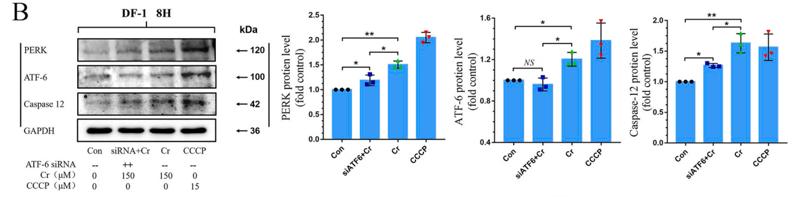
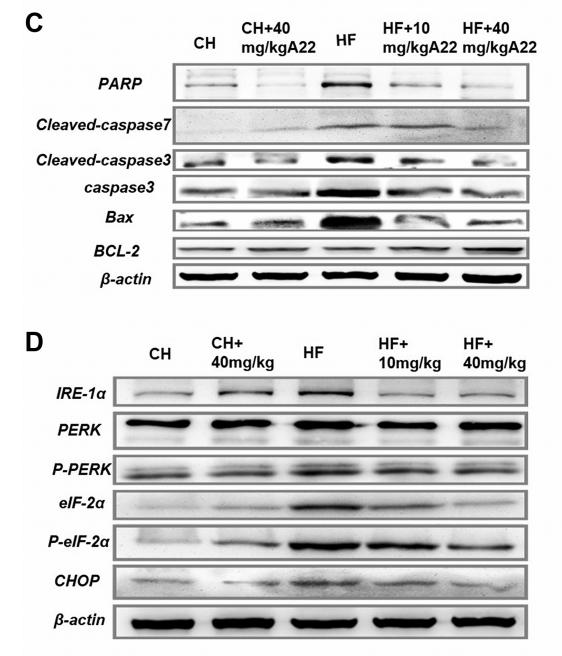
Figure 7. Effect of A22 on ameliorating apoptosis, ER stress, inflammation, metabolic syndrome, and fibrogenesis in HF diet-fed mice. (A) Effect of A22 on BCL-2 gene transcription. (B) Effect of A22 on BAX gene transcription. (C) Effect of A22 on expressions of apoptosis-related proteins in liver. The extracted proteins from the liver were immunoblotted with specific antibodies, and quantified based on the loading control of ACTIN. (D) Effect of A22 on ER stress. The UPR proteins (IRE-1, PERK, elF-2 and CHOP) were analyzed by using western Blot. (E) Effect of A22 on expressions of inflammatory factors. (F) Effect of A22 on expressions of fibrogenic proteins.

3). Two-Dimensional Iridium(III)−Carbon Nitride Nanocomplexes Induce Simultaneous Oncosis and Necroptosis for Synergistic Chemo- and Sono-Immunotherapy in Hypoxic Melanoma. Journal of the American Chemical Society, 2026 [IF=15.6]

4). Blood Brain Barrier-Crossing Delivery of Felodipine Nanodrug Ameliorates Anxiety-Like Behavior and Cognitive Impairment in Alzheimer's Disease. Advanced science (Weinheim, Baden-Wurttemberg, Germany), 2024 (PubMed: 38981028) [IF=15.1]

5). The role of ATF6 in Cr (VI)-induced apoptosis in DF-1 cells. JOURNAL OF HAZARDOUS MATERIALS, 2021 (PubMed: 33243643) [IF=12.2]

Application: WB    Species: chicken    Sample: DF-1 cells
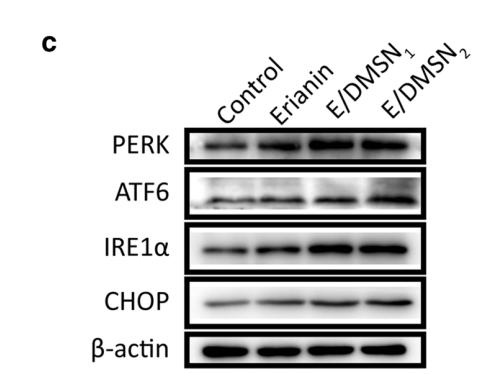
Fig. 6. Effects of ATF-6 on the different apoptotic pathway. (A) The mRNA expression levels of PERK, ATF-6 and Caspase-12 as detected by RT-qPCR. (B) PERK, ATF- 6 and Caspase-12 detected by Western blot and quantitative analysis the protein level. (C) The mRNA expression levels of Caspase-9, Bcl-2 and Bax inhibitor-1 as detected by RT-qPCR. (D) Proteins expression of pro Caspase-9, Bcl-2 and Bax detected by Western blot, quantitative analysis the protein level. (E) The mRNA expression levels of Caspase-8 as detected by RT-qPCR. (F) Expression of Caspase-8 and quantitative analysis of the protein level. All data were expressed as relative values against their respective control group. Data were presented as means ± SD (n = 3). NS P > 0.05, *P < 0.05, **P < 0.01.

6). Self-activated prodrug nanocomposites reprogramming lactic acid metabolism to initiate acidosis-endoplasmic reticulum stress cascade and potentiate immunogenic cell death for enhanced liver cancer therapy. Journal of nanobiotechnology, 2025 (PubMed: 41327195) [IF=10.2]

7). Development of erianin-loaded dendritic mesoporous silica nanospheres with pro-apoptotic effects and enhanced topical delivery. JOURNAL OF NANOBIOTECHNOLOGY, 2020 (PubMed: 32228604) [IF=10.2]

Application: WB    Species: Human    Sample: HaCaT cells
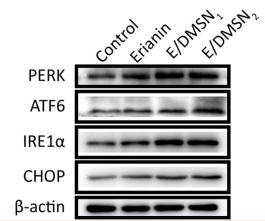
Fig. 5 Efect of erianin and E/DMSNs on cytosolic calcium levels and ERS signaling pathway. a Flow cytometry analysis of cytosolic calcium levels in HaCaT cells after treatment with erianin and E/DMSNs for 24 h. b Relative MFI of control in (a) analyzed by fow cytometry. c The expressions of PERK, ATF6, IRE1α, and CHOP proteins after treatment with erianin and E/DMSNs for 24 h. d Quantitation of PERK, ATF6, IRE1α, and CHOP proteins normalized to β-actin in (c) by using Image J software. Values are represented as means±SD (n=3). *p<0.05, **p<0.01, ***p<0.005, ****p<0.001, signifcantly diferent compared with the erianin group. ##p<0.01, ###p<0.005, ####p<0.001, signifcantly diferent compared with the control group

Application: WB    Species: Human    Sample: HaCaT cells

Fig. 5 Effect of erianin and E/DMSNs on cytosolic calcium levels and ERS signaling pathway. a Flow cytometry analysis of cytosolic calcium levels in HaCaT cells after treatment with erianin and E/DMSNs for 24 h. b Relative MFI of control in (a) analyzed by flow cytometry. c The expressions of PERK, ATF6, IRE1α, and CHOP proteins after treatment with erianin and E/DMSNs for 24 h. d Quantitation of PERK, ATF6, IRE1α, and CHOP proteins normalized to β-actin in (c) by using Image J software. Values are represented as means ± SD (n = 3). *p < 0.05, **p < 0.01, ***p < 0.005, ****p < 0.001, significantly different compared with the erianin group. ##p < 0.01, ###p < 0.005, ####p < 0.001, significantly different compared with the control group

8). RNF186 controls glucose metabolism in metabolic dysfunction-associated fatty liver disease. Cell & bioscience, 2025 (PubMed: 41316307) [IF=7.5]

Application: WB    Species: Mouse    Sample:

Fig. 4 RNF186 deficiency enhances glycogen synthesis, inhibits gluconeogenesis, and increases AKT signaling in skeletal muscle. A HE staining and PAS staining were performed on mouse skeletal muscle from WT and KO mice after 20 weeks of HFD treatment to evaluate glycogen accumulation (scale bar = 200 μm). B Glycogen content in skeletal muscle was measured in the indicated groups. C qPCR analysis was performed to evaluate the expression of gluconeogenesis-related genes in the indicated groups. D, E Western blot analysis and quantitative assessment were performed to evaluate the expression levels of p-AKT, p-GSK3β, p-PI3K, p-IRS1 and p-AMPKα in the indicated groups (n = 3). F, G Western blot analysis and quantitative assessment were performed to evaluate the expression levels of p-IRE1, p-eIF2α and p-PERK, in the indicated groups (n = 3). For all statistical plots, circles represent individual mice, the data are presented as mean ± S.E.M, and statistical significance is indicated as ns (not significant)

9). Acetylation of mtHSP70 at Lys595/653 affecting its interaction between GrpEL1 regulates glioblastoma progression via UPRmt. Free radical biology & medicine, 2024 (PubMed: 38281626) [IF=7.1]

10). Hypoxia-triggered autophagy modulates cisplatin resistance in non-small cell lung Cancer via EIF2AK3-dependent PI3K/AKT signaling and mTOR-independent mechanisms. Cell death discovery, 2025 (PubMed: 41353169) [IF=7.0]

Application: WB    Species: human    Sample: 95D cells

Fig. 1: Hypoxia upregulated EIF2AK3, HIF-1α, and autophagy in NSCLC cells. A549 and 95D cells were exposed to hypoxia for different durations (0, 6, 12, and 24 h). Protein expression levels of EIF2AK3, HIF-1α, and the LC3-II/I ratio were measured, and corresponding quantitative analyses were performed for A549 (A) and 95D (B) cells. Data are presented as mean ± SD from three independent experiments.

Load more

Restrictive clause


Affinity Biosciences tests all products strictly. Citations are provided as a resource for additional applications that have not been validated by Affinity Biosciences. Please choose the appropriate format for each application and consult Materials and Methods sections for additional details about the use of any product in these publications.

For Research Use Only.
Not for use in diagnostic or therapeutic procedures. Not for resale. Not for distribution without written consent. Affinity Biosciences will not be held responsible for patent infringement or other violations that may occur with the use of our products. Affinity Biosciences, Affinity Biosciences Logo and all other trademarks are the property of Affinity Biosciences LTD.