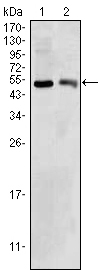
Product: BDH1 Antibody
Catalog: BF0318
Description: Mouse monoclonal antibody to BDH1
Application: WB IHC ELISA
Cited expt.: WB
Reactivity: Human, Mouse
Mol.Wt.: 38kDa; 38kD(Calculated).
Uniprot: Q02338
RRID: AB_2833761

View similar products>>

   Size Price Inventory
 50ul $250 In stock
 100ul $350 In stock
 200ul $450 In stock

Lead Time: Same day delivery

For pricing and ordering contact:
Local distributors

Product Info

Source:
Mouse
Application:
ELISA 1:10000, WB 1:500-1:2000, IHC 1:200-1:1000
*The optimal dilutions should be determined by the end user. For optimal experimental results, antibody reuse is not recommended.
*Tips:

WB: For western blot detection of denatured protein samples. IHC: For immunohistochemical detection of paraffin sections (IHC-p) or frozen sections (IHC-f) of tissue samples. IF/ICC: For immunofluorescence detection of cell samples. ELISA(peptide): For ELISA detection of antigenic peptide.

Reactivity:
Human,Mouse
Clonality:
Monoclonal [AFB1737]
Specificity:
BDH1 antibody detects endogenous levels of total BDH1.
RRID:
AB_2833761
Cite Format: Affinity Biosciences Cat# BF0318, RRID:AB_2833761.
Conjugate:
Unconjugated.
Purification:
Affinity-chromatography.
Storage:
Mouse IgG1 in phosphate buffered saline (without Mg2+ and Ca2+), pH 7.4, 150mM NaCl, 0.02% sodium azide and 50% glycerol. Store at -20 °C. Stable for 12 months from date of receipt.
Alias:

Fold/Unfold

3 hydroxybutyrate dehydrogenase (heart, mitochondrial); 3-hydroxybutyrate dehydrogenase; BDH; BDH_HUMAN; BDH1; D beta hydroxybutyrate dehydrogenase, mitochondrial; D-beta-hydroxybutyrate dehydrogenase; mitochondrial;

Immunogens

Immunogen:

Purified recombinant fragment of human BDH1 expressed in E. Coli.

Uniprot:
Gene(ID):
Description:
BDH1 (3-hydroxybutyrate dehydrogenase, type 1), it is a member of the short-chain dehydrogenase/reductase gene family. This protien forms a homotetrameric lipid-requiring enzyme of the mitochondrial membrane and has a specific requirement for phosphatidylcholine for optimal enzymatic activity. It catalyzes the interconversion of acetoacetate and (R)-3-hydroxybutyrate, the two major ketone bodies produced during fatty acid catabolism.
Sequence:
MLATRLSRPLSRLPGKTLSACDRENGARRPLLLGSTSFIPIGRRTYASAAEPVGSKAVLVTGCDSGFGFSLAKHLHSKGFLVFAGCLMKDKGHDGVKELDSLNSDRLRTVQLNVCSSEEVEKVVEIVRSSLKDPEKGMWGLVNNAGISTFGEVEFTSLETYKQVAEVNLWGTVRMTKSFLPLIRRAKGRVVNISSMLGRMANPARSPYCITKFGVEAFSDCLRYEMYPLGVKVSVVEPGNFIAATSLYSPESIQAIAKKMWEELPEVVRKDYGKKYFDEKIAKMETYCSSGSTDTSPVIDAVTHALTATTPYTRYHPMDYYWWLRMQIMTHLPGAISDMIYIR

Research Backgrounds

Subcellular Location:

Mitochondrion inner membrane. Mitochondrion matrix.

Extracellular region or secreted Cytosol Plasma membrane Cytoskeleton Lysosome Endosome Peroxisome ER Golgi apparatus Nucleus Mitochondrion Manual annotation Automatic computational assertionSubcellular location
Family&Domains:

Belongs to the short-chain dehydrogenases/reductases (SDR) family.

Research Fields

· Metabolism > Lipid metabolism > Synthesis and degradation of ketone bodies.

· Metabolism > Carbohydrate metabolism > Butanoate metabolism.

· Metabolism > Global and overview maps > Metabolic pathways.

References

1). β-Hydroxybutyrate suppresses M1 macrophage polarization through β-hydroxybutyrylation of the STAT1 protein. Cell death & disease, 2024 (PubMed: 39627223) [IF=8.1]

Application: WB    Species: Mouse    Sample: RAW264.7 cells

Fig. 4: Effects of β-OHB treatment on the regulation of M1 macrophage polarization. RAW264.7 cells were first treated with 10 mM β-OHB for 24 h, then cultured under β-OHB-free culture conditions for 24 and 48 h, and stimulated with 100 ng/ml LPS for 24 h. A Immunoblotting analysis of the Kbhb modification in the RAW264.7 cells (n = 3/group). B–D RT-qPCR analysis of IL-6, IL-12, and iNOS mRNA expression levels in the RAW264.7 cells (n = 3/group). The 9-week-old male C57BL/6 mice were orally administered 3 mg/g KE per day for 3d, and their BMCs were obtained and cultured with LCS for 7d to induce BMC differentiation into BMDMs. E, F RT-qPCR analysis of F4/80 and CD11b mRNA expression levels in the BMDMs (n = 3/group). G Immunoblotting analysis of the Kbhb modification in the BMCs treated with LCS at the indicated times (n = 3/group). Partial BMDMs were stimulated with 100 ng/ml LPS for 24 h. H–J RT-qPCR analysis of IL-6, IL-12, and iNOS mRNA expression levels in the BMDMs (n = 3/group). K BDH1 protein expression in mice liver lysates, HepG2 cells, BMDMs, and PMs. L Lack of BDH1 expression leads to β-OHB accumulation in macrophages, which may induce its Kbhb modification. BMDMs were transfected with either Ad-normal control (NC) or Ad-BDH1, then treated with 10 mM β-OHB for 24 h, followed by stimulation with 100 ng/ml LPS for an additional 24 h. M The intracellular β-OHB levels were measured (n = 3/group). N Immunoblotting analysis of the Kbhb modification in the BMDMs (n = 3/group). O–Q RT-qPCR analysis of IL-6, IL-12, and iNOS mRNA expression levels in the BMDMs (n = 3/group). R, S FCM analysis of the proportion of M1 phenotype (iNOS+/F4/80+) mouse BMDMs (n = 3/group). Data are presented as the mean ± standard deviation. *p 

2). 3-Hydroxybutyrate Suppresses Colon Cancer Growth by Inducing Intracellular Lactate Accumulation and Oxidative Stress. Journal of proteome research, 2025 (PubMed: 40476748) [IF=3.8]

Restrictive clause


Affinity Biosciences tests all products strictly. Citations are provided as a resource for additional applications that have not been validated by Affinity Biosciences. Please choose the appropriate format for each application and consult Materials and Methods sections for additional details about the use of any product in these publications.

For Research Use Only.
Not for use in diagnostic or therapeutic procedures. Not for resale. Not for distribution without written consent. Affinity Biosciences will not be held responsible for patent infringement or other violations that may occur with the use of our products. Affinity Biosciences, Affinity Biosciences Logo and all other trademarks are the property of Affinity Biosciences LTD.